Regulatory Updates
Foreign Investment from Land-Bordering Countries
An amendment to India’s foreign investment rules (effective May 02, 2026) now allows beneficial owners from land-bordering countries (such as China) to hold up to 10% non-controlling interest in Indian companies without requiring prior government approval. This 10% limit applies whether the investment is direct or indirect, individual or combined with others. Investments exceeding this threshold will still require prior government approval.
Income Tax Relaxations for Foreign Investors
An ordinance dated June 05, 2026, amends the Income Tax Act, 2025 to exempt Foreign Institutional Investors (FIIs) and the Bank for International Settlements (BIS) from capital gains tax on transfers, redemptions or interest income from Government Securities. This amendment applies retrospectively from April 01, 2026.
RBI Relaxes Debt Investment Norms for Foreign Portfolio Investments (FPIs)
The RBI has amended the FEMA (Debt Instruments) Regulations, 2019 to expand FPI investments in Government Securities by (i) removing General Route limits (including the 1-year short-term investment limit, concentration limits, and the 30% security-wise cap); and (ii) expanding the Fully Accessible Route (FAR) to include all new issuances of 15, 30, and 40-year Government Securities, as well as Sovereign Green Bonds (SGrBs).
SEBI Relaxations for Market Participants
Amid ongoing geopolitical tensions, SEBI has announced one-time relaxations. Observation letters for public issues expiring between April 01, 2026, and September 30, 2026 will remain valid until September 30, 2026. Penalties for non-compliance with Minimum Public Shareholding requirements are also suspended during this period.
SEBI’s Investor Protection Reform
SEBI has set up a dedicated agency called the Past Risk and Return Verification Agency (PaRRVA) (effective May 04, 2026) to independently verify the track record claims made by Investment Advisors, Research Analysts, and Algorithmic Trading providers. These entities can share their verified performance data with potential clients and third parties, helping investors make more informed decisions.
Legislative Updates
Liberalisation of India’s Insurance Sector
Effective May 02, 2026, the FEMA NDI Rules, 2019 were amended to permit 100% FDI in the insurance sector under the automatic route, subject to IRDAI approval and the requirement that at least one KMP is a resident Indian Citizen.
Promotion and Regulation of Online Gaming (PROG) Rules, 2026
The PROG Act, 2025 and the PROG Rules, 2026 (effective May 01, 2026), establish the Online Gaming Authority of India as a unified digital first-regulator. They introduce game classification, registration requirements, user safety measures (including age verification and parental controls), and a two-tier grievance redressal mechanism, enhancing regulatory clarity and consumer protection.
Jan Vishwas (Amendment of Provisions) Bill, 2026
Passed in April 2026, this Bill amends 79 central laws to convert minor criminal offences into civil violations and revise the associated fines and penalties. Key laws affected include the Drugs and Cosmetics Act, 1940, the Pharmacy Act, 1948, and the Electricity Act, 2003.
Labour Rules, 2026
The Ministry of Labour and Employment introduced rules (effective May 09, 2026) to bring into force the four labour codes that were notified in November 2025. These codes consolidate and replace 29 existing central labour laws, simplifying compliance for employers and clarifying rights for workers.
Recent Case Laws
Relief for Reliance Industries Limited (RIL) in a derivative trading case
The Supreme Court ruled in favour of RIL, setting aside an order that would have required RIL to return profits made from its November 2007 trades in Reliance Petroleum shares and futures. However, the Court upheld penalties for RIL’s delayed disclosure of its trading positions. Importantly, the Court clarified that hedging (protecting against price fluctuations) is a legitimate business activity. The Court also held that merely breaching position limits or disclosure requirements does not amount to fraud—there must be evidence of intent to deceive, inducement, or actual harm to investors.
SEBI Uncovers Fraud at Rajesh Exports Limited
SEBI issued an interim order dated June 03, 2026 against Rajesh Exports Limited, recording preliminary findings of financial misrepresentation, sham transactions, and diversion of company funds through related entities. These findings, covering the period from April 2020 to March 2024, suggest potential violations of securities fraud regulations and disclosure requirements. As this is an interim order, final conclusions are yet to be determined.
Predictive Insights
India’s Emerging AI Framework
The Supreme Court of India has released draft regulations on artificial intelligence and invited public feedback. The proposed rules would require AI systems to comply with constitutional principles, principles of natural justice (fairness in decision-making), and responsible use standards. Separately, the government has formed a high-level inter-ministerial body; the AI Governance and Economic Group to coordinate AI policy development across ministries.
Political Overview
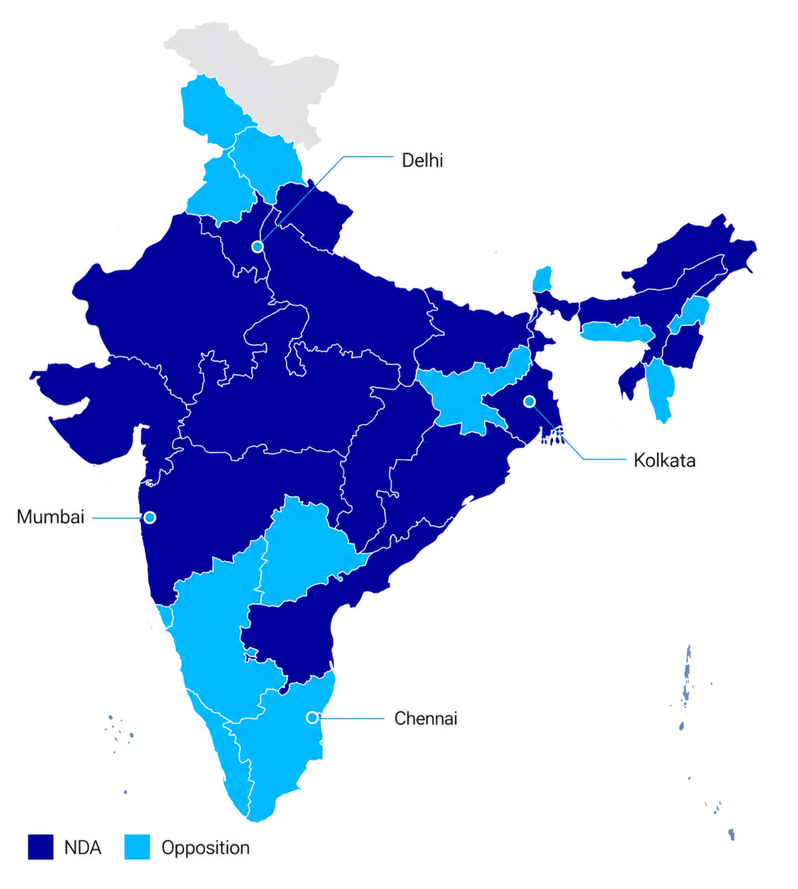
Following recent state-level elections, the ruling National Democratic Alliance (NDA) has expanded its presence across more states. This greater alignment between central and state governments may enable faster implementation of uniform regulatory frameworks across the country. The map below shows which states are now governed by the ruling coalition versus the opposition.